 | About Us | 4x4 Vehicles |
Accessories | Executives | Testimonials | Contact | FAQ |
Buy
| About Us | 4x4 Vehicles |
Accessories | Executives | Testimonials | Contact | FAQ |
Buy
Soni Motors Thailand :: [email protected]
Phone/WhatsApp/Viber/LINE: Jim: +66-89-106-5701 :: Sam: +66-86-677-5701
Thailand, Dubai, Australia and UK's Top Exporter of new used Diesel 4x4 pickup, cars, SUV. Facebook Fan Page
Do It Yourself Monthly Auto Maintenance
The days of the full-service gas station are gone, and modern cars can go 30,000 miles or more without a tune-up. So it's up to YOU to check the little things before they become big, expensive problems by checking under the hood of your car on a regular basis.
Following these simple monthly checks will alert you to potential problems that can be dealt with before you get stranded or end up paying for expensive auto repairs.
- Check your car's Fluids and change it if required and fix the container if the fluid is leaking
- Check your car's or 4x4's hoses
- Check your Car's or 4x4's belts
- Check your car's and 4x4's engine for leaks
- Other Monthly Checks to Perform on your car
- Your Shopping List for Ongoing Auto Maintenance
Check Your Car's Fluids
First a word of caution on fluids - particularly for import cars. Car manufacturer's are required to specify in their owner's manuals all the fluids to be used in your car and the manufacturer's OE specifications for each. Make sure to check here first - BEFORE adding any fluids to your car.
It is also required that OE oils and coolants must be mixable with "off the shelf" products to allow for emergency service. It may not be the best thing for your engine long-term, but you can add plain old 30W oil to $5 a quart synthetics and the same goes for coolants and water.
On the other hand, however, are the hydraulic oils (i.e., power steering, brake fluid, transmission fluid, differential/axle, etc.). These must be at certain specifications for viscosity and liquid type (petroleum vs. mineral vs. synthetic). Hence, it's critical that you know what products to be adding to your car according to the specifications given in your owner's manual.
Check the Oil
Check the oil when the engine is warm. Oil expands when it's hot and contracts when it's cold; different temperatures will give you different readings.
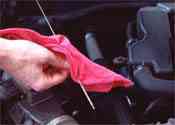
Here are the steps to follow to check your car's oil:
- Park the car on a level surface.
- Turn off the engine. It's best to wait at least 10 minutes to give the oil a chance to drain down into the crankcase. Otherwise, you might think you're as much as a quart low when you're not.
- Open your hood.
- Find the dipstick - a long piece of metal sticking out of the engine usually located near the spark plugs with a loop at one end . Many dipsticks now have a "T" handle or are incorporated into the fill cap. If you don't find the loop, look for these.
- Pull on the loop and draw the dipstick all the way out.
- Wipe the oil off the dipstick with a paper towel or shop rag.
- Replace the clean dipstick, making sure to push it all the way in; then pull it back out and hold it horizontally in front of you.
- Look at the pointed end of the dipstick. If the oil on the dipstick is below the line marked "full", add a small amount of oil (less than a quarter of a quart) with a funnel. Many dipsticks simply have two lines with a cross hatch design in between. The oil level should be halfway between these two lines.
- Add oil by unscrewing the oil filler cap, which is about 3 inches in diameter and is located on the very top of the engine.
- Check the oil level with the dipstick after adding oil. Add more if necessary. It's easy to add more oil but difficult to remove oil if you add too much so add slowly and continue rechecking.
- Put the oil filler cap back on and secure it tightly.
It's best to always keep two quarts of oil in your car. Your owner's manual will tell you what type of motor oil your engine requires and this may vary on the season/weather. If you're in a pinch or you only need to add a little, it's okay to mix types - for example, 10W-40 with 10W-30.
The oil lubricating system is a closed system. This means that the oil does not get "used up" or go anywhere. If it's consistently low, there may be an oil leak. Leaks always get worse, and losing all the engine oil will require expensive repairs and/or replacing the engine. Make sure to further investigate (on your own or with the help of a qualified mechanic) if your car seems to have an oil leak.
You may want to read Engine Knock? Low Oil Pressure? Engine How To Diagnose Needed Repairs for further information on this topic.
You may also want to check out The Motor Oil Bible: Exposing The Myth of the 3000 Mile Oil Change & More! for an easy-to-understand, comprehensive and informative book on motor oil.
Check the Brake Fluid
Check the brake fluid when you check all the other fluids. It's easy to do and only takes a minute.
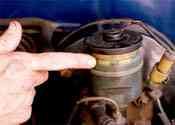
Here are the steps to follow to check your car's brake fluid:
- Find the brake master cylinder. This is usually located under the hood on the driver's side of the car, toward the back of the engine compartment. Imagine where your brake pedal would end up if it went all the way through to the engine. The brake master cylinder is a small (about 6 by 2 inches), rectangular piece of metal with a plastic reservoir and a rubber cap on top, with small metal tubes leading from it.
- Check your owner's manual if you aren't sure that you've found the master cylinder. The rubber cap will usually read "Use only DOT 3 or 4 brake fluid from a sealed container."
- Note that on most newer-model cars the reservoir is translucent and you can see the fluid level without removing the cap. There will be a "Full" line - the brake fluid should be at this line.
- In older cars (pre-1980), the brake master cylinder reservoir may be made entirely of metal so you must take the top off to check the fluid level. The top is held on by a metal clamp - use a screwdriver to pop off the clamp and lift the lid.
- Add brake fluid to the "Full" line. If the reservoir has two parts, fill both halves. Use the correct brake fluid for your car. Check the rubber cap and your owner's manual to find out what grade of brake fluid your car requires. Most cars use DOT (Department of Transportation) 3 or 4.
Brake fluid is very toxic. Keep it away from hands and eyes and avoid spilling it on the ground. Dispose of empty containers carefully and be especially careful not to spill brake fluid on your car's paint. Always wash your hands well after handling brake fluid.
If the brake master cylinder is empty, the brake pedal will go to the floor. If this is the case, you will have to bleed the brakes in addition to adding fluid. It's probably best to see your mechanic, who will be able to flush and refill the braking system. Never drive a car that has run out of brake fluid until bleeding the brakes!
You may want to read Brake Repairs Needed? Don't Take Chances with Your Brakes - Repair Them Now for further information on this topic.
Check your Radiator fluid or Coolant
Radiator fluid, or coolant, is the most important part of your car's cooling system, which protects your engine from overheating. Low coolant can lead to a breakdown and expensive repairs.
Here are the steps to follow to add coolant to a newer-model car (1970 and after):
- Note that only much older models of cars (pre-1970s) require you to add coolant directly to the radiator. Newer vehicles feature a reservoir (expansion tank) that you can access anytime. Beware: Some German and Swedish cars (and others) have a reservoir that's under pressure (pressure cap on the tank vs. a flip-off type plastic top) and these should not be opened when the engine is hot. If you're driving an older model car, see the steps below for older models.
- Look for the plastic reservoir tank, which should at least be holding some residue of coolant (normally green, although there are also red versions available on the market). It's often labeled, is near the radiator and has a hose leading to the radiator. The hose to the radiator is the tip off that you aren't pouring coolant into your windshield wiper reservoir.
- Unscrew the cap and add coolant to the "Full" line. Coolant is a 50-50 mixture of purified (not tap and not distilled) water and antifreeze/coolant. Do not add straight water if the reservoir is completely empty as this can cause your car to overheat.
Make sure to check your owner's manual to see if your car is required to use a coolant specifically formulated for your car's make.
If your car is overheating and the reservoir is under pressure, don't try to remove the reservoir cap. You could be seriously burned.
Here are the steps to follow to add coolant to an older model car (pre-1970s):
- Make sure the engine is cool before adding coolant directly to the radiator. If the car has been running recently, wait at least half an hour before unscrewing the radiator cap.
- Find the radiator cap at the very front of the engine near the hood latch.
- Rotate and remove the cap using a rag. When in doubt about whether it's safe to unscrew the cap, use several rags and unscrew the lid slowly. If your car is overheating, don't try to remove the radiator cap. You could be seriously burned.
- Look into the radiator. If the fluid doesn't reach the radiator's top just below the opening for the cap, add coolant. As with the newer-model cars, be sure to check your owner's manual in case your car requires a coolant specifically formulated for your car's make.
Coolant is poisonous but that won't stop pets from drinking it. It tastes sweet to them. Don't leave it lying around and be sure to clean up any spills.
As with many of the other fluids in your car, coolant does not get "used up". If the reservoir or radiator is low, chances are your car may have a leak that needs to be checked out.
Check Power Steering Fluid (if applicable):
Checking power steering fluid on most cars is easy, though not all cars have it. If you can parallel park with one hand and eat an ice cream cone with the other, then you have power steering.
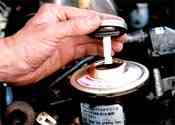
Here are the steps to follow to check your power steering fluid:
- Locate the belts. The power steering pump is driven by a pulley and a belt and has a clear plastic or metal (usually round) reservoir on top of it. The power steering cap will often say "power steering".
- Check the fluid level either by looking at the side of the reservoir (if you have the clear plastic type) or by unscrewing the cap (for the metal type). Some reservoirs may have a small dipstick attached to the cap. Typically, you have a choice between checking the fluid warm or cold, and there will be corresponding "Hot" and "Cold" levels.
- Add fluid if necessary. Use only the proper type of power steering fluid for your car. Check your car's owner's manual and the bottle. Some cars require power steering fluid specifically designed for that make of car.
In addition to checking your power steering fluid monthly, you'll also want to check both the fluid level and the power steering belt if you hear a squeal when you turn the steering wheel all the way to one side.
As with motor oil, power steering fluid does not get "used up". Other than a leak, there's no reason that the fluid should be low. Fill the reservoir to the proper level and check frequently if you find it low. If it continues to be low, check for leaks and get them fixed. An empty power steering pump can be damaged very quickly and is costly to replace.
Check Automatic Transmission Fluid (if applicable):
If you have an automatic transmission, you'll want to check the automatic transmission fluid (ATF) every month and whenever the transmission isn't shifting smoothly. Here are the steps to follow:
- Park your car on level ground and start the engine, leaving the gear in neutral or park. Wait for the engine to warm up. Unless your owner's manual directs otherwise, allow the engine to continue running throughout this procedure. (With some cars, the engine should not be running while you check the fluid, so be sure to consult your owner's manual.)
- Find the ATF dipstick, located at the back of the engine. The ATF dipstick is often shorter than the engine oil dipstick but otherwise looks similar. If you're lucky, it will be labeled.
- Pull on the dipstick and completely remove it. It may be very long.
- Wipe the dipstick with a rag, replace it in the transmission, push it all the way in and remove it again.
- Look at the dipstick's tip. Observe whether there are two different full markings: one for cold readings and one for warm reaings. If so, read the one for "Warm". If the ATF does not come up to the line marked "Full", add ATF. Be careful not to overfill. Filling above the full line causes the fluid to foam. Also, excessive pressure build-up may damage the transmission.
There are two major types of ATF: Dexron (also called Mercron) and Type F; your owner's manual should tell you which one you should be using. Some cars require ATF specifically designed for that car make.
When refilling ATF, do not allow the fluid to contact the exhaust manifold. It can cause a fire. You may also want to turn the engine off before adding the fluid. It can be dangerous if the fluid spills, hits the fan and splashes into your eye.
ATF fluid does not get "used up", so if it's low, you probably have a leak. Do not ignore leaks or drive around with low ATF. It can lead to very expensive transmission repairs.
Check Hydraulic Clutch Fluid (if applicable):
Cars with manual transmissions (stick shift) use either hydraulics (which use fluid) or a cable to connect the clutch pedal to the transmission. If your car has a hydraulic clutch, the fluid must be checked monthly to ensure that it's full and there aren't any leaks.
Here are the steps to follow to check your car's hydraulic clutch fluid - after you've identified you have one, of course:
- Turn the engine off and open the hood.
- Look for a small plastic container about 1 inch in diameter, located close to the back of the engine - usually near the brake fluid reservoir. It looks a lot like the brake fluid reservoir but it's smaller. Imagine that the clutch pedal went straight through into the engine compartment. This is where you'll find the clutch master cylinder and clutch reservoir.
- Check the fluid level. The reservoir is usually clear with a small round rubber cap on the top. It should be filled to the top. If it's low, add brake fluid. There is no such thing as "clutch fluid". See notes on brake fluid for cautions. The hydraulic clutch uses brake fluid. Cars with a clutch cable do not use any fluid (these are not hydraulic clutches).
- Replace the cap.
If the clutch reservoir is consistently low, you probably have a leak. The reservoir is very small so even a little leak can empty it out quickly. Without fluid, your clutch pedal is useless and you won't be able to shift or drive.
A leak can often be seen at the reservoir/clutch master cylinder, at the other end of the clutch hydraulic line at the clutch slave cylinder or inside the car behind the clutch pedal. If you suspect a leak, check it out immediately.
Check Windshield Washer Fluid
These steps will show you that keeping your wiper fluid reservoir full is a snap. Here are the steps to follow:
- Turn off the engine. Make sure your car is cooled down before attempting this check. If a hose bursts or slips, you can be scalded with hot water or antifreeze.
- Find the windshield wiper fluid reservoir, usually a plastic jug filled with blue windshield washer fluid. It has a hose leading toward the windshield. Take care not to confuse it with the coolant reservoir, which may look similar. The coolant reservoir will have a hose that connects to the radiator. If you're not sure you've found the windshield wiper fluid reservoir, don't add the fluid. Consult your car's owner's manual.
- Flip open the top of the reservoir.
- Add fluid if the fluid level is low - less than 3/4 full or below the fill line printed on the jug. Fill it to the top. Do not add plain water. Windshield wiper fluid has detergent in it to clean your windshield and also antifreeze to prevent it from freezing in the reservoir or on the windshield.
- Close the reservoir lid, making sure it's on securely.
Check Your Car's Hoses
Old radiator hoses or loose clamps can cause a coolant leak, which will lead to overheating and expensive repairs. Check hoses periodically and replace them if they're aged or leaking.
Here's how to check your hoses:
- Locate the radiator - it's always at the front of the car.
- Locate the radiator hoses. Two hoses should be attached to the radiator - an upper hose at the top and a lower hose at the bottom.
- With the engine cold, squeeze each hose. If the hose feels "crunchy" or brittle, it's old and needs replacing. Repeat this for any other hoses your car may be equipped with.
- Check the clamps at either end of the hoses. If the hose is damp or wet at the clamp, tighten or replace the clamp. The clamps should be tight enough that the hose cannot be turned or moved.
- Check the hoses for cracks, tears or frayed ends. If you find any, replace the hose immediately.
It's always a good idea to replace the upper and lower radiator hoses whenever you replace your water pump or radiator.
Check Your Car's Belts
If your belts make a horrible shrieking sound when you press on the gas pedal, they are too loose and probably need to be tightened or replaced.
A broken belt is painful to the wallet - it can cost much more than just the price of a new belt. Get into the habit of checking out the belts on your car from time to time and have all the belts changed periodically to ensure you can avoid major repair bills.
Here are the steps to follow to check your belts:
- Turn off the engine. Let the engine cool before checking the belts and be careful around hot engine parts.
- Find the belts located at the very front of the engine. On a front-wheel-drive car, the front of the engine is usually adjacent to the fender; on a rear-wheel-drive car, the front of the engine is adjacent to the radiator and the front bumper.
- Note that there will be two or more belts, depending on the car. Belts are used to operate the fan, water pump, alternator, air conditioner, power steering pump and smog pump.
- Press lightly with your thumb on each belt at the belt's longest part between the pulleys. Note that on serpentine-type belts, the push test is not very accurate because the belt tensioner can move when you press on the belt. Manufacturers recommend using a tension gauge on these types of belts, not the push test.
- Check the appropriate tension for your belts in your car's owner's manual. Belts should not have more than 1 inch of "give" in either direction.
- Observe the belt as you press on it. If it's cracked or can be easily pushed more than 1 inch, it most likely needs to be replaced.
Check Your Car's Engine For Leaks
Except for gasoline and windshield wiper fluid, the fluids in your car should not get used up or go anywhere. If you notice that any are low, there's a good possibility of a leak.
Here are the steps to follow to check for leaks:
- Understand that the fluids you may have in your car are gasoline, oil, coolant, brake fluid, windshield washer fluid, gear oil, power steering fluid and automatic transmission fluid. All cars will have at least gas, oil and brake fluid. Air-cooled engines (like old VW bugs) do not have coolant. Your model of car may or may not have power steering or automatic transmission fluid.
- Open the hood and visually inspect the engine and engine compartment. Many leaks are easily detectable with just a simple look.
- Note that you don't need to know the name of the fluid that's leaking or the name of the part it's leaking from to be able to find a leak. As a clue, green, sticky fluid is coolant. Bluish, watery liquid is windshield wiper fluid. Honey- or dark-colored, greasy fluid is engine oil. Honey- or dark-colored thick fluid with a chestnut smell is gear oil. Clear or yellowish liquid with a very slippery consistency is brake fluid. Slippery reddish fluid is automatic transmission or power steering fluid. Gasoline will evaporate when it leaks out and may not leave any residue but it's easy to smell.
- Inspect underneath the engine and the car with a flashlight. Look for wet areas or drips clinging to the underside of the car's carriage.
- If you don't see any signs of a leak, lay down a large piece of corrugated cardboard and park your car so the engine sits over it. With a pen, mark the position of the wheels.
- Remove the cardboard the following morning. Note the position of any drip marks relative to the wheel markings. This information will help you and/or your mechanic diagnose the problem.
Other Monthly Checks to Do
Here are a few other items you'll probably want to check on a monthly basis:
- Visually inspect the battery for corrosion at the cable ends.
- Make sure the dash lights, headlights, taillights, brake lights, back-up lights and turn signals are in good working order.
- Start the engine and listen with the hood up (after doing this a few times, you will learn what sounds "normal" for your car). You may want to read Troubleshooting Noises Coming From Your Import Car for some insight into some of the more common noises.
- Check your windshield wipers (do not touch the blades themselves - the oil on your fingers causes them to deteriorate) to ensure they have good contact with your windshield and are not dry or cracked. You may want to read Replacing Wiper Blades Regularly Saves Lives & Windshields for further information on this topic.
- Check the tire pressure on all the tires, including the spare. Visually inspect the tires for uneven wear or nails or other sharp objects lodged in the tread.
By following these guidelines, your car should provide you with many years of trouble-free driving and you should be able to avoid breakdowns and some of the avoidable major repairs.
You may also want to read Tuneup & Auto Maintenance Tips to Lengthen Your Import Car's Life for further information on general maintenance procedures for your car.
Your Ongoing Auto Maintenance Shopping List
Here is a list of parts you may need for ongoing maintenance:
- Brake Fluid -
- Motor Oil -
- Coolant & Purified Water -
- Automatic Transmission Fluid -
- Windshield Washer Fluid -
- Selection of Fuses -
- Bulbs for Operational Lights -
- Spark Plugs -
- Spark Plug Wires (Ignition Wire Set) -
- Distributor Cap and Rotor -
- Oxygen Sensor -
- Oil Filter -
- Air Filter -
- PCV Breather Filter -
- Fuel Filter -
- Transmission Filter -
- Vacuum Hoses -
- Temperature Sensors -
- Lubricants -
- Coolant Hoses -
- Belts -
- Tire Gauge -
 |
 |
 |
| Return to our page on Automotive Articles | Return to Index Page | Email us now at [email protected] |
The Soni Group of Companies or its subsidiary companies shall not be liable for any loss or damage caused by the usage of any information obtained from this web site. Companies referred to in this web site shall not be construed as agents nor as companies recommended by Soni Motors Thailand or the Soni Group or any of its subsidiaries.
© 2001-2018 :: Soni Motors Thailand - a division of
the Soni Group ::
All rights reserved ::
 [email protected]
 | About |
4x4
| Commercial Trucks | Accessories |
Executives |
Testimonials | Contact |
| About |
4x4
| Commercial Trucks | Accessories |
Executives |
Testimonials | Contact |
Toyota Hilux Revo | Toyota Hilux Vigo | Mitsubishi L200 Triton | Nissan Navara | Toyota Fortuner | Mitsubishi Pajero Sport Isuzu DMax | Isuzu MU-7 | Chevy Colorado | Ford Ranger | Mazda BT-50 | Mitsubishi Fuso | Nissan UD Trucks | Hino Commercial Trucks | Isuzu Commercial Trucks